Halal Certification for Cosmetics: What JAKIM Requires
Many brand owners assume that once their factory holds a Halal certificate, their own products can carry the Halal logo. In Malaysia, that is not how it works. Halal certification for cosmetics is issued product by product. The factory's certificate is a separate document with a different job.
JAKIM is the Department of Islamic Development Malaysia. This guide explains what it checks, who applies, what it costs and what goes on your label. It is based on JAKIM's Malaysia Halal Certification Procedure Manual (Domestic) 2020. The manual states that a contract manufacturing certificate cannot be used as Halal certification for the products a factory makes. If you are choosing a Halal OEM manufacturer, this one rule shapes how you plan your launch.
Is Halal Certification for Cosmetics Mandatory in Malaysia?
No. Malaysia's Ministry of Health confirms that Halal certification is not needed to notify a cosmetic product. The Halal logo may only be used on products certified by JAKIM. Certification is voluntary, and the manufacturer or distributor applies for it.
Voluntary does not mean every brand can skip it. Three groups of buyers tend to ask for it:
- Retail and pharmacy buyers in Malaysia who stock products for Muslim shoppers.
- Importers in Muslim majority markets such as Indonesia, the UAE and Kazakhstan.
- Export markets with their own rules. Indonesia makes Halal certification mandatory for cosmetics from 18 October 2026.
If you are planning a skincare OEM project for any of these channels, decide on Halal at the brief stage. Changing a formula after samples are approved costs time.
The Two Certificates Most Brands Mix Up
JAKIM runs nine certification schemes. Two of them matter when a factory makes cosmetics for your brand.
The contract manufacturing (OEM) scheme covers the factory. Under the 2020 manual, a company must hold this certificate before it can offer contract manufacturing to other companies. It shows the factory runs a Halal system. It does not certify any product.
The cosmetic product scheme covers the products. Every product that will carry the Halal logo needs its own application under this scheme. The applicant can be the manufacturer, a repacker or the brand owner.
The manual also requires a written contract or agreement between the factory and the brand owner. Settle this before production starts, along with who applies for the product certificate.
| Contract manufacturing (OEM) certificate | Cosmetic product certificate | |
|---|---|---|
| Who holds it | The factory | The manufacturer, a repacker or the brand owner |
| What it covers | The factory's Halal system and its contract manufacturing service | The specific products listed on it |
| Lets your product carry the Halal logo | No | Yes |
| When you need it | Before the factory can offer OEM work | Before your product carries the logo |
This applies whichever model you choose: OEM, ODM or private label. A ready formula sold under your brand still needs a certificate that lists your product name. Only then can the logo go on your pack.
What JAKIM Checks Before It Certifies a Cosmetic
JAKIM looks at the company, the ingredients, the factory and its staff. These checks come from the 2020 manual.
Company and Regulatory Basics
Before an application is accepted, the applicant needs:
- A valid business registration with the Companies Commission of Malaysia (SSM) and a licence from the local authority.
- NPRA notification for every cosmetic product in the application, or an NPRA letter allowing manufacture for export only.
- A factory that meets the cosmetic GMP guideline in Malaysia's guidelines for the control of cosmetic products.
- At least three months of full operation, and three months of records, before a new application.
Each product must also meet MS 2634:2019, the Malaysian Standard for Halal cosmetics. If NPRA notification is new to you, start with our registration and compliance guidance.
Ingredients and Suppliers
Every raw material must be declared exactly as it appears on its label. The application must also name its original manufacturer. JAKIM then looks at where each ingredient comes from.
In an interview with ChemLinked, the director of JAKIM's Halal Management Division set out the rule. Animal ingredients must hold a Halal certificate from JAKIM or a recognised foreign body. Ingredients without a certificate need documents showing their composition, source and production process. He also said JAKIM prefers ingredients that do not come from animal or alcohol sources.
Three areas need the most checking in a cosmetic formula:
- Animal actives such as collagen, gelatine and keratin. Check the source and the certificate behind each one.
- Colourants. Carmine (CI 75470) is made from insects, and certification bodies do not all treat it the same way. This matters for lip products and other colour cosmetics.
- Alcohol. Alcohol from alcoholic drinks is not acceptable. Ask your manufacturer for the source and grade of any alcohol in the formula. For perfume, an alcohol free base is one route, and our fragrance OEM page lists the formats we make.
Production, Storage and Staff
Processing and storage areas must handle Halal materials and products only. A company that makes or distributes both Halal products and products that are not Halal cannot apply.
The manual also sets staffing rules by company size:
| Company size (annual turnover) | Muslim staff in the processing area | Halal role | Control system |
|---|---|---|---|
| Large and medium (RM15 million and above) | At least 2 permanent Malaysian Muslim staff on every shift | Halal Executive and an Internal Halal Committee | Halal Assurance System (HAS) |
| Small (RM300,000 to under RM15 million) | At least 1 | Halal Supervisor | Internal Halal Control System (IHCS) |
| Micro (under RM300,000) | At least 1 | None specified | IHCS |
The Internal Halal Committee needs at least four members: a chair, the Halal Executive, someone from purchasing and someone from production. New staff need Halal awareness training within three months of joining, with a refresher at least every three years.
As a brand owner, these are the factory's duties. You still need to know they are in place, because the audit checks them.
Products and Brand Names JAKIM Will Not Certify
The 2020 manual lists cases that are not eligible. Several of them catch beauty brands out:
- One brand for Halal products and products that are not Halal. Using the same brand for both is not allowed for products used in Malaysia. If part of your range cannot meet Halal rules, sell it under a separate brand.
- "Halal" in a name. Company, product, ingredient and brand names cannot use the word Halal or suggest it.
- Names linked to products that are not Halal. The manual gives examples such as beer and rum. Check fragrance names in particular.
- Hair dye and nail colour. The manual lists both among products that are not eligible.
- Products still in early R&D. A late stage product can qualify only if four things are true. Its raw materials are available. Its formula and label are fixed. A trial run has been done on the production line. And management has approved it.
- Finished products that are only relabelled in Malaysia without any processing.
These exclusions are specific, so most skincare, body care and fragrance formats are not affected. Check your range against the list before you brief a manufacturer. If you are still shaping your range, see the product categories we make.
How the JAKIM Application Works
Applications are made online through MYeHALAL on JAKIM's Halal Malaysia Portal, where the procedure manual is also published. The 2020 manual sets out these steps:
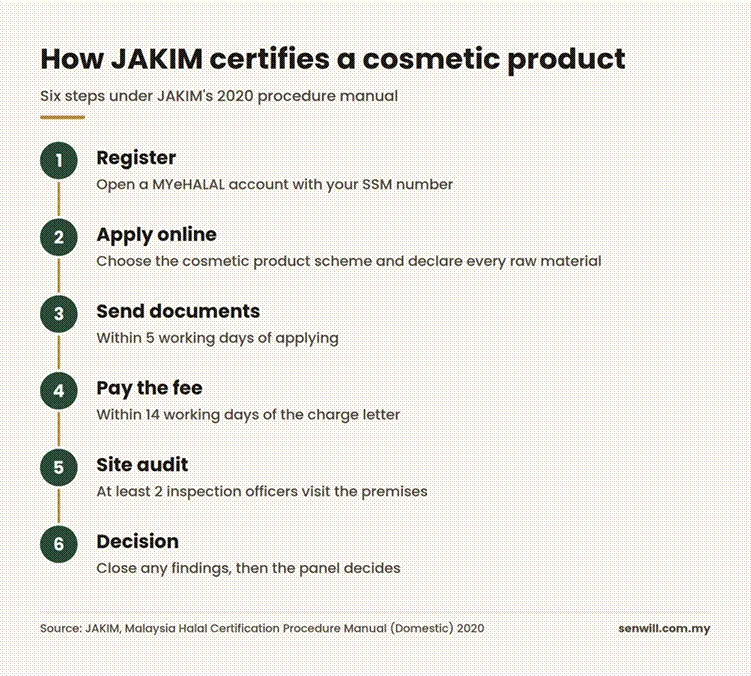
- Register a MYeHALAL account using your SSM registration number. JAKIM confirms new accounts within 24 hours on working days.
- Submit the application online. Choose the cosmetic product scheme and declare every raw material. One application can cover up to 100 products.
- Send supporting documents within five working days of submitting.
- Document review. An inspection officer checks the application and can ask for more information.
- Pay the fee within 14 working days of receiving the charge letter. If payment is late, the application is rejected and you start again.
- Site audit. At least two inspection officers visit the premises once the fee is paid.
- Close any findings by the deadline the officers set.
- Decision. JAKIM's Malaysian Halal Confirmation Panel decides, and the certificate is issued.
Renewals must be filed between six and three months before the certificate expires. A certificate that lapses is treated as a new application, so mark the renewal window in your calendar.
JAKIM does not publish a fixed overall timeline, and it says timing depends on each application. Incomplete ingredient documents are one of the common causes of delay it names.
What Certification Costs
The 2020 manual sets a RM20 processing fee per application, plus a yearly certification fee based on annual turnover:
| Company size | Annual turnover | Certification fee per year |
|---|---|---|
| Micro | Under RM300,000 | RM100 |
| Small | RM300,000 to under RM15 million | RM400 |
| Medium | RM15 million to RM50 million | RM700 |
| Large | Over RM50 million | RM1,000 |
JAKIM's portal notes that the certification fee covers a two year period. The applicant also pays for any laboratory tests on ingredients. Companies registered outside Malaysia pay more when their products are made under contract in Malaysia. They pay a RM200 processing fee, then RM2,500 per application for ASEAN countries or RM10,000 for other countries.
The fee is charged to the applicant, so agree in your contract who applies and who pays. Check the portal for current rates before you set a budget.
What Goes on a Halal Cosmetic Label
Under the 2020 manual, a certified product's label must show:
- The product name, exactly as registered in MYeHALAL.
- The name and address of the certificate holder.
- The Malaysian Halal logo, with the Malaysian Standard number (without the year) and the last 10 digits of the file reference number.
Products processed and packed in Malaysia need labels in Bahasa Melayu, and other languages can be added. Labels and adverts cannot use religious terms or names of God, or show images of pigs or dogs.
The second point matters more than it looks. The holder's details are printed on every pack. Agree who holds the product certificate before your first print run. Need help with label information and print ready files? Our packaging team can review your drafts before you print.
How to Check a Manufacturer's Halal Certificate
Before you sign with a Halal OEM manufacturer, ask to see its certificate and check these points:
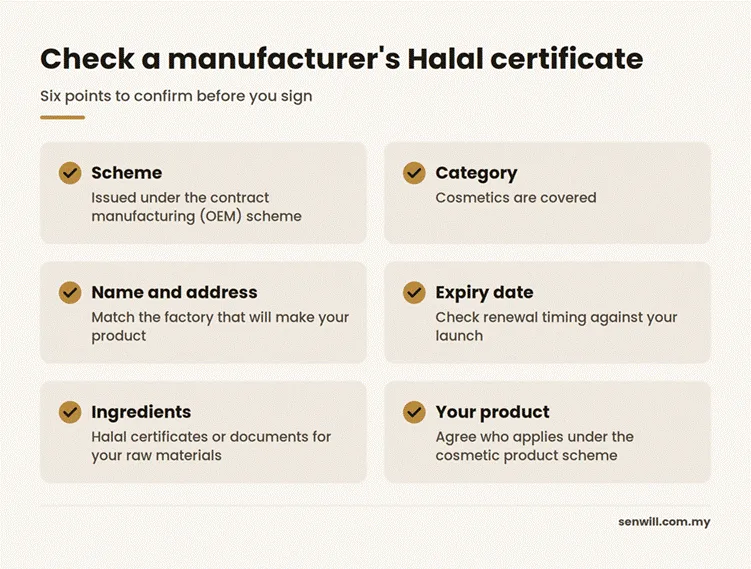
- Scheme. Is it issued under the contract manufacturing (OEM) scheme? A certificate for the factory's own products is not the same thing.
- Category. The manual requires a separate OEM application for each product category, so check that cosmetics are covered.
- Name and address. These should match the factory that will make your product.
- Expiry date. Check the date, and ask when renewal is due if it falls inside your launch window.
- Ingredients. Ask whether the raw materials in your formula already have Halal certificates or the supporting documents JAKIM needs.
- Your product. Agree in writing whether you or the factory will apply under the cosmetic product scheme, and who pays.
You can also check a certificate yourself. The Halal Malaysia Portal has a Verify Halal Status search with separate categories for cosmetics and for contract manufacturing (OEM). If a factory cannot show a certificate under the right scheme, it cannot offer you Halal contract manufacturing.
Selling Outside Malaysia
Indonesia's Halal agency, BPJPH, confirmed on 16 September 2026 that mandatory Halal certification starts on 18 October 2026 without delay. Cosmetics are within scope, as reported by CIRS Group. CIRS advises exporters to confirm their Halal certificate and its registration status in Indonesia. It also advises leaving time for checks before shipment.
Other markets have their own certification bodies. JAKIM keeps a list of foreign bodies it recognises. Rules on alcohol and insect based colours can differ between them. If you sell in more than one market, build the formula around the strictest rule you face. It saves reformulating later. You can see the markets Senwill already ships to, across Southeast Asia, the Middle East and Central Asia.
Frequently Asked Questions
Is Halal Certification Mandatory for Cosmetics in Malaysia?
No. It is not needed for NPRA notification. You need it to use the Halal logo, or when a buyer or export market asks for it.
Can I Use the Logo If My Factory Is Certified?
Not on that basis alone. The factory's contract manufacturing certificate does not certify your product. Each product needs its own certificate under the cosmetic product scheme.
Who Should Apply, the Brand Owner or the Manufacturer?
Either can. Under the cosmetic product scheme, the manufacturer, a repacker or the brand owner can apply. The holder's name and address go on the label, so agree this in your contract.
Can a Halal Cosmetic Contain Alcohol?
Alcohol from alcoholic drinks is not acceptable, and JAKIM prefers ingredients that do not come from alcohol sources. Ask your manufacturer about the source and grade of any alcohol before you approve a sample.
How Long Does JAKIM Certification Take?
JAKIM does not publish a fixed timeline. Some steps have set deadlines: documents within five working days of applying, and fees within 14 working days of the charge letter. Missing ingredient documents are a common cause of delay.
Do I Tell JAKIM If I Change the Formula?
Yes. JAKIM asks certificate holders to inform its Halal Management Division of any change to a certified product. Adding a new raw material supplier without telling JAKIM in writing counts as a minor finding at audit.
Does a JAKIM Certificate Cover Indonesia?
Indonesia runs its own mandatory scheme through BPJPH from 18 October 2026. Check how your certificate is recognised or registered there before you ship.
Getting Halal Right From the First Batch
Halal certification for cosmetics in Malaysia comes down to three things. You need a factory certified under the contract manufacturing scheme. You need a product certificate for each item that carries the logo. And you need ingredient records that hold up at audit. Agree who applies, who pays and whose name goes on the label before production starts. If you sell into Indonesia, plan for its rules now.
Planning a range? To talk through the Halal documents each product will need, contact our team in Penang.