Private Label Cosmetics: What to Know Before You Launch
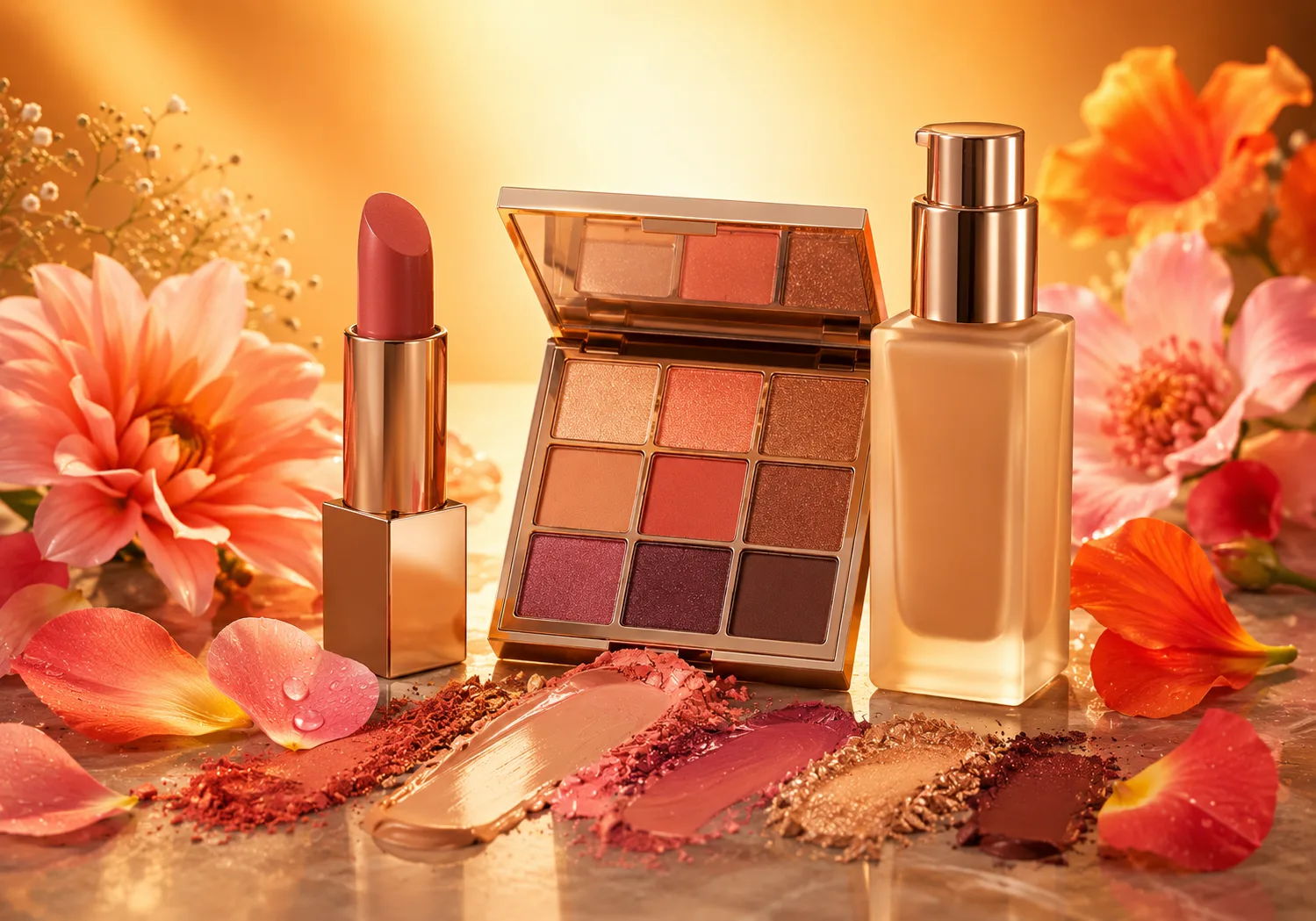
Private label cosmetics let you sell skincare, makeup, hair care and body products under your own brand without building a factory or hiring a chemist. A manufacturer makes the product from a formula it has already developed and tested. You choose the formula, the packaging and the label, and you sell the finished product as yours.
That first part is usually simple. The parts that catch new brand owners out come later: who registers the product with the regulator, what really sets the minimum order, who owns the formula, and what changes when you sell in more than one country. Most guides skip these points because they are written for a single market. This guide covers them for brand owners selling in Malaysia, across ASEAN and into Halal markets such as Indonesia and the Middle East.
What Are Private Label Cosmetics?
Private label cosmetics are beauty and personal care products made by one company and sold under another company's brand. The manufacturer owns the factory, the equipment and usually the base formula. You own the brand name, the packaging design and the customer relationship.
The term comes from retail, where supermarkets sell store brands made by outside suppliers. In the general definition, a private label product is produced for a single client who decides its specifications, while a white label product is designed by the manufacturer and can be sold to many brands at once. In cosmetics the two terms are often used loosely, so ask each supplier what they mean by them before you compare quotes.
In practice, a private label cosmetic starts from a proven base. You can usually adjust the scent, the colour or a key ingredient within limits, then fill it into your own packaging. The base has already been through stability testing, which is why this is the quickest way to get a product on shelf. At Senwill, this is the private label route for brand owners who want to test a market before paying for a custom formula.
Private Label vs White Label vs OEM
These three routes sit on a scale from fastest to most unique. The table shows how they compare.
| White label | Private label | OEM (custom formulation) | |
|---|---|---|---|
| Formula | The manufacturer's standard formula, unchanged | The manufacturer's base, adjusted for you | Developed from your brief |
| What you can change | Label and packaging | Packaging, label and some formula details such as scent or colour | Formula, texture, active ingredients and packaging |
| Who else can sell it | Other brands sell the same product | Depends on your agreement | Usually only you |
| Speed to market | Fastest | Fast | Slowest, because of development and testing |
| Typical minimum order | Lowest | Low to medium | Highest |
| Best for | Testing demand | Launching a real brand quickly | A hero product nobody else has |
You may also see ODM, where the manufacturer develops the product concept and formula and you customise the result. Factories do not all use these labels the same way. Some call a custom formula ODM and others call it OEM, so judge each offer by what it includes rather than by its name.
A common path is to start with private label to prove demand, then move a best seller to a custom formula once its sales justify the development cost.
What You Can Sell Under a Private Label
Almost any cosmetic or personal care product can carry a private label. The categories below are the ones brand owners ask about most, and each has its own practical points.
Skincare
Private label skincare is the largest category. Cleansers, toners, serums, moisturisers, masks and sunscreen all come in proven bases. A private label facial cleanser or moisturiser is a common first product because customers use it every day and reorder it often. For the full range of private label skincare products, see our skincare OEM options.
Makeup
Lipsticks, lip matte, foundation and primers can all be made as private label makeup. Colour is the hard part: each shade is its own batch, which affects your minimum order. Many brand owners start with lipstick and lip products because a short shade range is easier to manage than a full face range. Our cosmetics OEM page lists the formats.
Hair and Body Care
Shampoo, conditioner, hair serum, body wash, body lotion and hand soap are steady repeat purchases, which makes them good for building a customer base. They usually come in larger packs, so check freight costs and shelf space as well as the unit price. See our hair care and body care options.
Fragrance
Perfume, reed diffusers and essential oil blends can be private labelled too. Here the scent is the product, so ask how far the manufacturer can adjust a base scent and whether the same scent is also sold to other brands. Our fragrance page covers the formats.
How Private Label Cosmetics Work, Step by Step
Most private label projects follow the same seven steps. The order matters, because skipping a step usually costs more time later than it saves now.
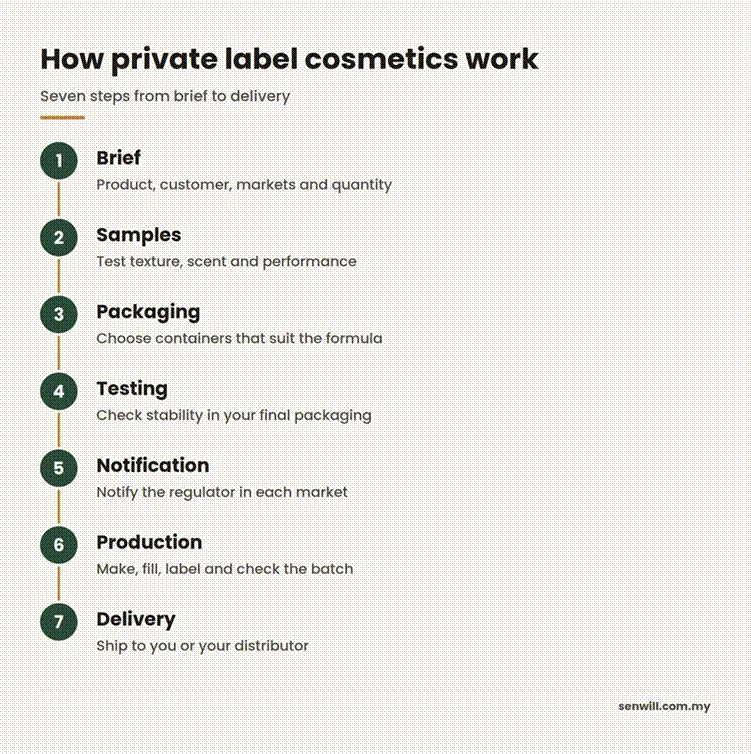
- Brief. Tell the manufacturer the product type, your target customer, the markets you will sell in and the quantity you expect to order.
- Samples. Test the samples for texture, scent and performance. Ask for changes now, while they are cheap to make.
- Packaging. Choose bottles, jars, tubes and boxes, and confirm they suit the formula. Some formulas react with certain plastics or pumps.
- Testing. The manufacturer checks that the formula stays stable in your final packaging over time.
- Notification. The responsible company notifies the regulator in each market before the product goes on sale.
- Production. The batch is made, filled, labelled and checked by quality control.
- Delivery. Finished goods are packed and shipped to you, your warehouse or your distributor.
Steps 3 and 4 are linked. If you change the packaging after stability testing, the test may need to be repeated, so settle your packaging early.
What Drives the Cost and the Minimum Order
Two quotes for what looks like the same product can differ a lot. These are the main reasons.
| Cost factor | Why it matters |
|---|---|
| Formula base | Simple bases cost less than formulas with high levels of active ingredients. |
| Changes to the base | Each change to scent, colour or actives may need new samples and new testing. |
| Packaging | Custom printed or imported packaging often has its own minimum order and lead time. |
| Number of shades or scents | Each shade or scent is a separate batch, so more variants mean more minimums. |
| Testing and documents | Stability tests, product files and certificates add cost to each product. |
| Registration | Each market needs its own notification. In Malaysia, NPRA charges RM50 for each product and each variant. |
| Order size | Larger batches spread setup and cleaning costs across more units. |
Packaging Often Sets the Real Minimum
Brand owners tend to focus on the manufacturer's minimum order quantity (MOQ) and forget the packaging. A factory may be able to fill a small batch, but a supplier of custom printed bottles or boxes may need a far larger order. Stock packaging with a printed label or sleeve is the usual way to keep a first order small. Senwill's packaging and label support covers sourcing, label information and print ready artwork.
Makeup Minimums Apply per Shade
For colour cosmetics, the minimum usually applies to each shade, not to the product line as a whole. Five lipstick shades can mean five minimum orders. A foundation range with many shades multiplies this quickly, which is why many new brands launch with a short shade range and add more once they see what sells.
Who Registers Your Product?
This is the question most private label guides skip, and it matters more than price. In most markets, one company must take legal responsibility for a cosmetic before it can be sold. Whoever holds that responsibility holds a lot of control over your product.
Notification in Malaysia and ASEAN
Malaysia and the other ASEAN countries use cosmetic product notification rather than full approval. According to NPRA's cosmetic notification FAQ, the company placing a cosmetic on the Malaysian market must notify NPRA before the product is made, imported or sold, and that company must be registered in Malaysia. A foreign brand has to appoint a Malaysian registered company as the holder. A product notified in Malaysia must also be notified separately in every other ASEAN country where it will be sold.
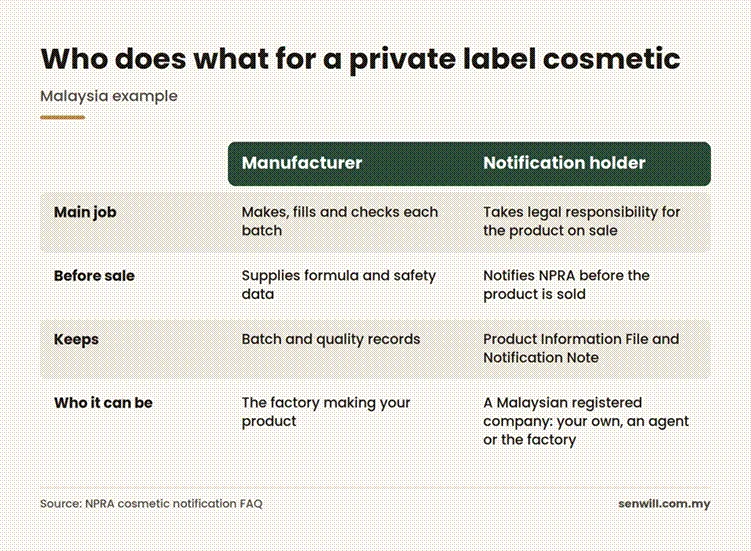
In a typical private label project, the manufacturer makes, fills and checks each batch, keeps the batch and quality records, and supplies the formula and safety data. The notification holder takes legal responsibility for the product on sale: it notifies NPRA, keeps the Product Information File (the technical and safety file regulators can ask to see) and holds the Notification Note. The holder can be your own Malaysian company, an appointed agent or the manufacturer itself.
The key point for brand owners is control. Only the company that notified the product can print its Notification Note, the document that authorises the product to be sold. If your manufacturer or an agent holds the notification for private label cosmetics you sell in Malaysia, agree in writing how it will be handled if you part ways. A notification is valid for two years, so also agree who renews it.
Switching Supplier Means New Paperwork
Moving to a new manufacturer is more than placing an order somewhere else. NPRA treats a change of manufacturer or formula as a notification change, and a new brand name needs a new notification. Plan for that paperwork, and the time it takes, before you switch.
Claims Can Change the Category
What you print on the label can turn a cosmetic into a drug in some markets. The US FDA explains that an antidandruff shampoo is both a cosmetic and a drug, and that moisturisers and makeup sold with sun protection claims fall into the same group. It also notes that sunscreens are regulated as cosmetics in Europe but as drugs in the US.
So if you plan to sell an antidandruff shampoo or a sunscreen, check the claim rules in each market before you print the label. Malaysia has its own extra step for whitening products: NPRA asks for a certificate of analysis within one month of notification.
Halal for Muslim Markets
If you sell to Muslim customers, Halal often shapes the buying decision, and in Indonesia it is now a legal requirement. Indonesia's halal agency, BPJPH, confirmed in June 2026 that cosmetics sold in Indonesia must be halal certified from 18 October 2026, with no delay to that date.
For private label products, Halal status depends on the base formula, every ingredient and the factory. Ask the manufacturer which products its certificate covers before you put a Halal claim on your label.
Who Owns the Formula?
With private label, the base formula usually belongs to the manufacturer. You own your brand name, your artwork and your customer list, but not the recipe. That has two practical effects.
First, the same base may be sold to other brands, so ask whether any part of your version is exclusive to you. Second, if you move factories, you take your brand with you but not the formula, and the new product will need its own testing and notification.
With custom OEM work, the formula is developed for your brief, and ownership can be agreed in your contract. If owning the formula matters to your long term plans, raise it before development starts, not after launch.
How to Choose a Private Label Cosmetic Manufacturer
Price matters, but these questions tell you more about whether a manufacturer can support your brand:
- Certificates. Which quality certificates does the factory hold, and do they cover the products you want? Ask to see the certificates, not just a logo.
- Samples. How many sample rounds are included, and what does each change cost?
- Testing. Is stability testing done in your final packaging?
- Registration support. Who will notify your product in each market, and who keeps the documents?
- Exclusivity. Will the same base be sold to other brands in your market?
- Minimums. What is the minimum per product, per shade and per packaging item?
- Export experience. Has the factory shipped to your target markets and supplied the documents they require?
- Path to custom. Can a private label product be developed into your own formula later?
Senwill has made cosmetics and personal care products in Penang since 2008 and is ISO 9001:2015 and GMP certified. You can read more about our factory and team.
What to Prepare Before You Ask for a Quote
A useful quote needs clear inputs. Before you contact a manufacturer, have answers to these:
- Product category. Skincare, makeup, hair, body, fragrance or a mix.
- Brand stage. New, ready to launch, established or already exporting.
- Estimated quantity per order. Even a rough figure such as 500, 1,000 or 5,000 units changes the price and the options.
- Target markets. Where you sell decides the registration, labelling and Halal needs.
- Packaging idea. Stock or custom, and any reference products you like.
- Timing. Your launch date and whether it is fixed.
The first three are what Senwill asks in its WhatsApp enquiry, because together they decide which route and which minimum order fit your brand.
Frequently Asked Questions
How Is Private Label Different From White Label?
White label products are standard formulas sold unchanged to many brands, with only the label changed. Private label beauty products start from a manufacturer's base but are adjusted and packaged for one brand, so you usually get more control over scent, colour and presentation.
How Long Does a Private Label Launch Take?
It depends mainly on sample rounds, packaging lead times and registration. In Malaysia, NPRA generates a notification number within one to three working days after payment, but samples and custom packaging usually take much longer. Ask your manufacturer for a timeline that lists each step.
Can I Start With a Small Order?
Yes. Private label has the lowest minimums of the custom routes, and many manufacturers, including Senwill, offer small orders for new brands. Minimums can apply per shade and per packaging item, so a short range keeps a first order small.
Do I Need to Register the Product Myself?
Someone must. In Malaysia, the company that notifies NPRA must be registered in Malaysia, and foreign brands appoint a local holder. Each ASEAN country needs its own notification, so agree in writing who holds it in each market.
Can I Switch to My Own Formula Later?
Yes, and many brands do. Once a product sells well, a custom version can be developed through OEM. In Malaysia a change of formula counts as a notification change, so plan the switch with your manufacturer.
Are Private Label Cosmetics Halal?
Only if the formula, the ingredients and the production are covered by a Halal certificate. Ask which products the manufacturer's certificate covers. In Indonesia, cosmetics must be halal certified from 18 October 2026.
Is Private Label the Right Start for Your Brand?
Private label cosmetics are the quickest, lowest risk way to put your own brand on shelf. They suit brand owners who want to test a market, build a customer base or add products to an existing range. They suit a brand less if its whole story rests on a formula nobody else has, which is what custom OEM is for.
Whichever route you choose, settle three things early: who holds the registration in each market, what really sets your minimum order, and who owns the formula. Get those right and the rest of the launch is far easier to plan.
If you are weighing up your first product, send us your brief with your product category, brand stage and expected quantity, and our team will suggest the route that fits.