What Is OEM Manufacturing? How It Works for Beauty Brands
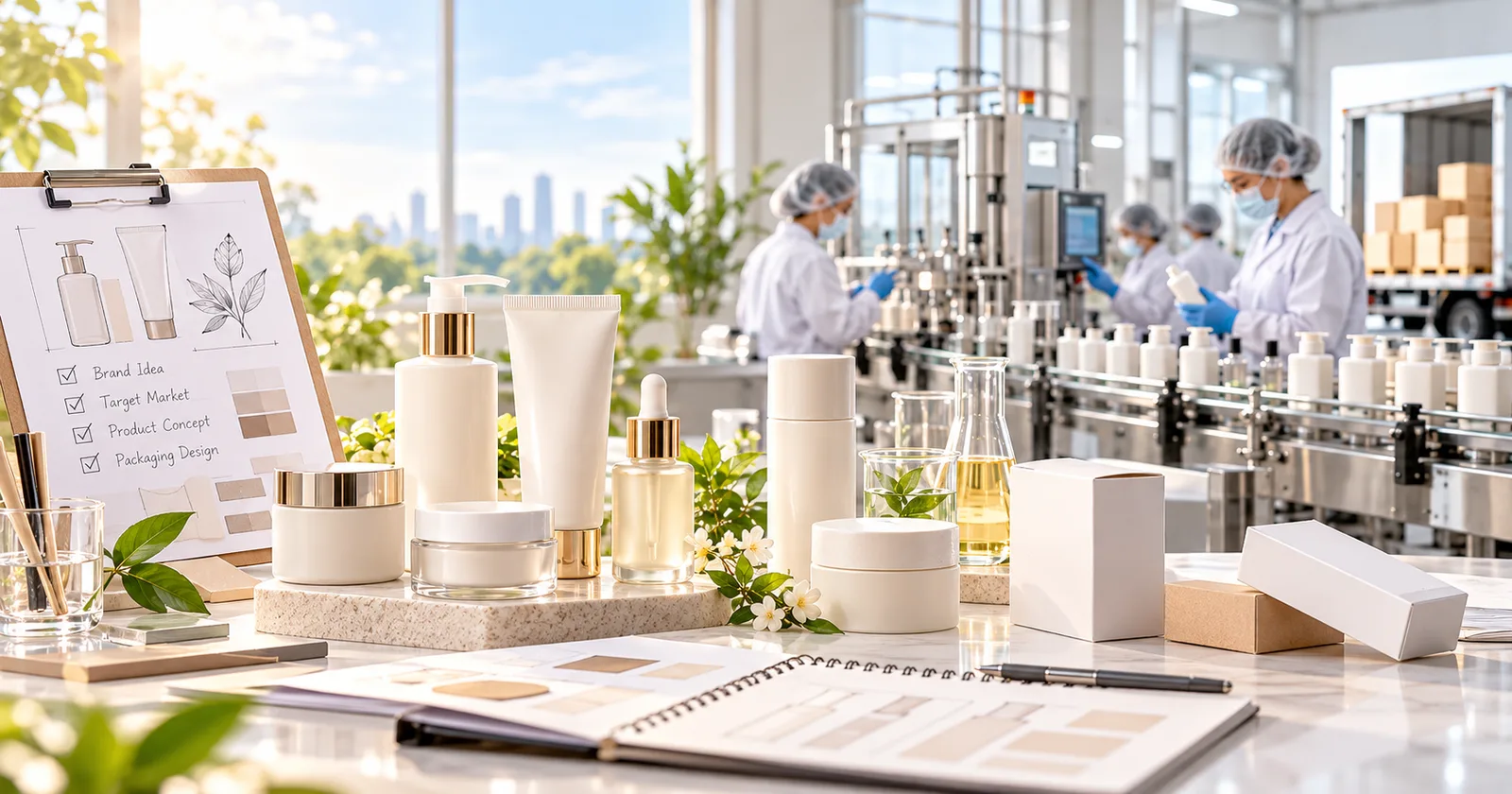
You have a product idea, a brand name and a market in mind, but no factory. That is the gap OEM manufacturing fills. A manufacturer makes the product to your brief, and you sell it under your own brand. Many skincare, perfume and personal care brands work this way, from new labels to household names.
This guide explains what OEM manufacturing means, who does what, how a product moves from brief to finished stock, and who owns the formula at the end. It is written for beauty and personal care brand owners, so the examples are formulas and bottles, not engine parts.
What OEM Manufacturing Means
OEM stands for original equipment manufacturer. In OEM manufacturing, one company makes a product to another company's requirements, and that second company sells it under its own brand name.
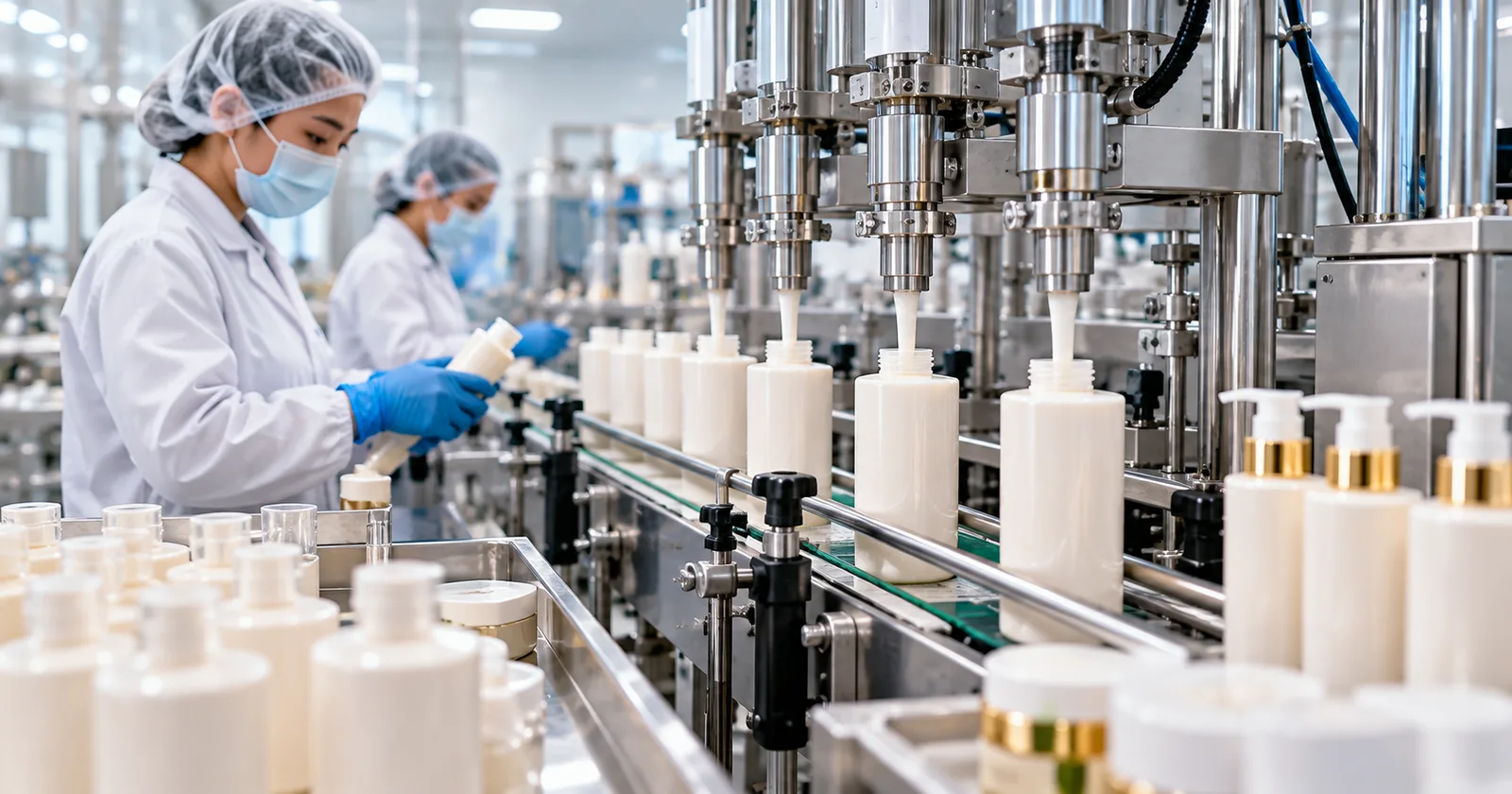
In beauty and personal care, this usually means the factory develops a formula to your brief, fills it into the packaging you chose and delivers finished stock with your label on it. You look after the brand, the marketing and the sales. The factory brings the lab, the production lines, the quality checks and the experience. You can see the range of products an OEM factory can cover in the categories we manufacture.
OEM is not the same as buying ready stock to resell. The product is made for your brand, to your requirements, in batches you order.
Why the Term Confuses People
Search for OEM and you will find two meanings that point in opposite directions. In the car and electronics trades, the OEM is often the brand that designs the product and puts its name on it. In Asian contract manufacturing, including cosmetics, OEM usually means the factory that makes products for other brands.
The entry for original equipment manufacturer on Wikipedia notes that the term is ambiguous and has several common meanings. Neither use is wrong. What matters is what a supplier means when it says it offers OEM. For a cosmetics factory in Malaysia, it usually means this: we make it, you brand it, and the product is built around your brief rather than our catalogue.
Who Does What in an OEM Arrangement
OEM works because each side sticks to what it does best. The table below shows a typical split for a skincare or personal care product. The exact split depends on your contract, so agree it in writing.
| Task | Brand owner | OEM manufacturer |
|---|---|---|
| Product idea and target customer | Leads | Advises on what is possible |
| Formula development | Gives feedback and approves samples | Develops and adjusts the formula |
| Raw materials | Approves key ingredients | Sources and checks them |
| Packaging and artwork | Chooses and approves | Checks it suits the formula |
| Product notification | Holds it, or appoints a holder | Supplies technical documents |
| Production and quality control | Agrees the specification | Makes each batch and checks it |
| Marketing and sales | Owns fully | Optional support |
Malaysia's cosmetics regulator, the NPRA, builds this split into its rules. Its glossary for the cosmetic guidelines defines the product owner as the legal owner of the formula or process. It names a separate Cosmetic Notification Holder, who is responsible for placing the product on the market and must be a company incorporated in Malaysia. It also expects appointment and acceptance letters between the product owner and the contract manufacturer that set out each side's role.
In other words, the regulator expects you to know who owns what before the first batch. A good OEM partner will prepare the technical documents for this. Ask whether your factory offers registration and compliance guidance or expects you to handle it alone.
How OEM Manufacturing Works, Step by Step
Every factory words it differently, but an OEM project for a cosmetic or personal care product usually runs through six stages.
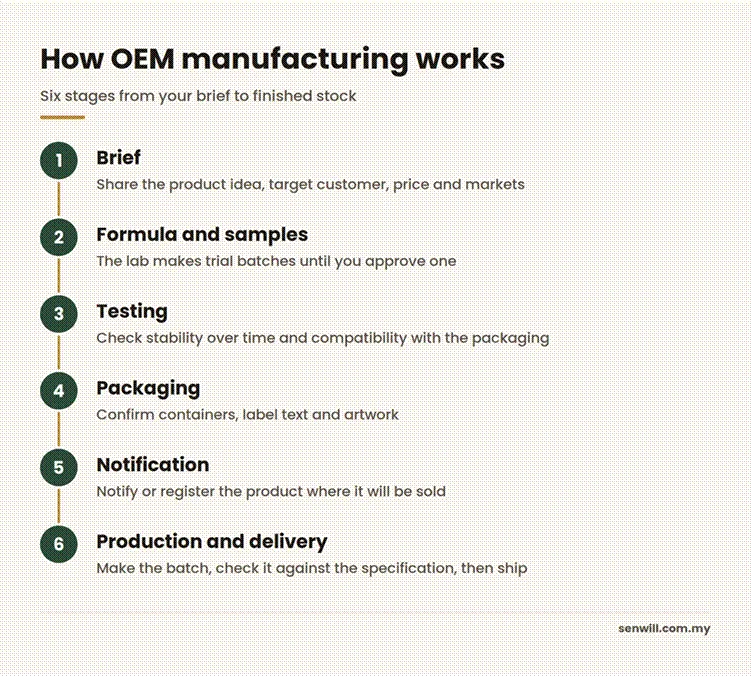
Step 1: Share Your Brief
The brief is the most useful document you will write. It covers what the product does, who it is for, the texture or scent you want, the claims you hope to make, your target retail price and where you plan to sell. A reference product you like helps a lot. You do not need a formula. Turning your brief into one is the factory's job.
Step 2: Develop the Formula and Samples
The lab makes trial batches and sends you samples. Expect a few rounds of changes to texture, scent or colour before you approve one. This is where a factory's R&D and custom formulation team does most of its work. Ask how many sample rounds the quote includes.
Step 3: Test Stability and Compatibility
Once you pick a sample, it is tested to see whether it stays stable over time and at different temperatures, and whether it reacts with the packaging. A cream that separates in a hot warehouse, or a pump that clogs, is far cheaper to catch now than after launch. Ask which checks and tests are included and which cost extra.
Step 4: Finalise Packaging and Labels
Bottles, jars, pumps and boxes have their own lead times and minimum orders, and these can take longer than the product itself. Label text must meet the rules of each market you sell in, from the ingredient list to the name of the company responsible. Factories that offer packaging and label support can check your artwork and formula together.
Step 5: Notify or Register the Product
Most major markets require cosmetics to be notified or registered before they go on sale. In Malaysia, the notification holder does this with the NPRA. For export, the rules of the destination country apply, and some buyers and markets also ask for Halal documents. Build this step into your timeline rather than leaving it until stock is ready.
Step 6: Produce, Check and Deliver
The factory makes your batch, checks it against the agreed specification, fills and packs it, then releases it for delivery. Reorders follow the same approved formula and specification, so each batch matches the last.
What the Design Means for Formulated Products
Most guides to OEM manufacturing are written for machined parts, where the client hands over technical drawings and pays for custom tooling. Beauty, fragrance and drink products work differently. The design is a formula, and it often does not exist yet when you first call the factory.
Here is what the design usually covers in three common categories:
- Skincare and body care: the active ingredients, texture, scent, pH and preservative system. For OEM skincare, the brief often starts with a reference product and a claim, such as hydration or brightening.
- Fragrance: the scent, its strength and the format, such as a spray or a reed diffuser. With perfume and fragrance projects, the scent is the product, so who owns it matters even more.
- Coffee: the blend, sweetness, creamer and any functional ingredients. Instant and 3 in 1 coffee falls under food rules, so it needs food safety documents rather than a cosmetic notification.
Physical tooling still exists, such as bottle moulds and printing plates. For most beauty brands, it sits with the packaging supplier rather than the factory that fills the product. That is why the formula, not the mould, is usually the asset to protect.
Who Owns the Formula?
Guides to OEM manufacturing often disagree here. Some say the client always owns everything. Others say ownership is usually shared. Both can be true, because the answer depends on your contract, not on the word OEM.
For a formulated product, it helps to separate three things:
- The brand: your name, logo and packaging design. Register your trademark in each market you plan to sell in.
- The formula: the exact ingredients, amounts and process. If the factory built it on one of its own bases, it may keep the rights to that base. If it was developed from scratch for you, the contract can assign it to you.
- The notification: the regulatory record for the product in each market. It belongs to whoever is named as the notification holder.
Formulas can be patented, but many companies keep them as trade secrets instead. As WIPO's guide to trade secrets explains, trade secrets need no registration, but they stay protected only while the information is kept confidential. So your real protection is the contract and its confidentiality terms.
Before you sign, check that the agreement answers these questions:
- Who owns the final formula, and can the factory sell it to anyone else?
- If you move production, do you receive the full formula or only a specification?
- Are your brief, samples and sales data kept confidential?
- Who holds the product notification, and what happens to it if you part ways?
How OEM Compares With ODM and Private Label
OEM is one of three common routes to your own product. The main difference is where the formula starts.
| OEM | ODM | Private label | |
|---|---|---|---|
| Starting point | Your brief | A proven base from the factory | A finished formula from the factory |
| How unique | Highest | Medium | Lowest |
| Speed to market | Slowest | Faster | Fastest |
| Best for | A signature product | Building out a range | Testing demand |
Many brands mix routes, such as an OEM hero serum alongside ODM cleansers. You may also see the term contract manufacturing. In cosmetics it is often used to mean the same thing as OEM, while in engineering it usually means the client supplies the full design. To see how the three routes work in practice, read our overview.
Benefits and Trade Offs of OEM Manufacturing
OEM is a good fit for many brands, but not all of them. Weigh both sides before you commit.
Benefits
- No factory to build: you skip the cost of equipment, premises and production staff.
- Lab and quality systems from day one: you use a manufacturer's existing R&D team, testing and production controls.
- A product built around your idea: the formula is made to your brief, not picked from a catalogue.
- Room to grow: reorders run on production lines that already exist.
Trade offs
- More time: developing a new formula takes longer than ODM or private label.
- Minimum orders: both the product and the packaging usually have a minimum order quantity.
- Dependence on one partner: the factory's quality record and capacity become your problem too.
- Ownership is not automatic: rights and confidentiality only hold if they are written into the contract.
What to Check Before You Choose an OEM Manufacturer
A call and a factory visit will tell you a lot. Use the six points below to compare suppliers on the same terms.
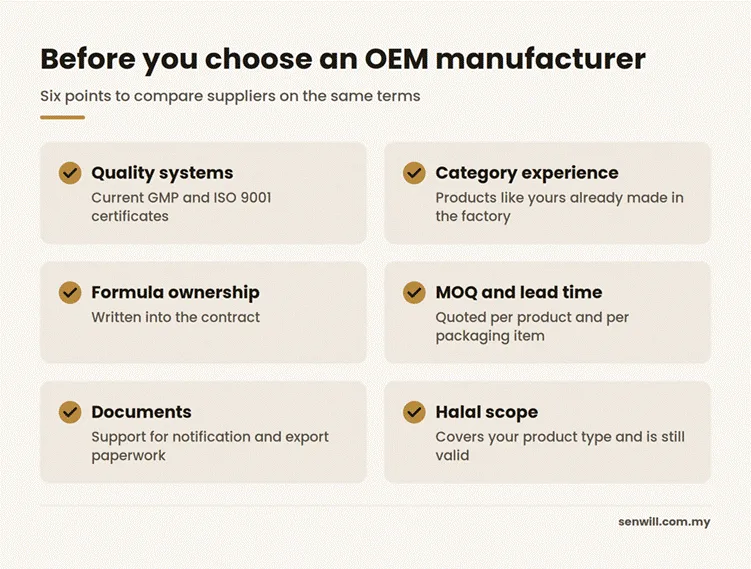
- Quality systems. Ask for current certificates. For cosmetics, Good Manufacturing Practice (GMP) is the baseline. The international reference is ISO 22716, which gives guidelines for the production, control, storage and shipment of cosmetic products. ISO 9001 shows the company runs a documented quality management system.
- Category experience. A factory that makes serums every week may not be right for lipstick. Ask to see products like yours.
- Formula ownership. Get the terms from the ownership section above into the contract.
- MOQ and lead time. Ask for both, per product and per packaging item, in writing.
- Documents. Check the factory can supply what your notification and export markets need.
- Halal scope. If you sell to Muslim markets, confirm the certificate covers your product type and is still valid.
Frequently Asked Questions
What Does OEM Mean in Manufacturing?
OEM stands for original equipment manufacturer. In beauty and personal care, it usually means a factory that makes products to another company's brief, which that company then sells under its own brand.
Is OEM the Same as Private Label?
Not quite. Both put your brand on a product someone else makes. With private label, you choose a formula the factory already has. With OEM, the formula is developed or adapted to your brief, so it is more unique and takes longer.
Is OEM Manufacturing Only for Large Brands?
No. Small and new brands use OEM factories because building their own plant is not realistic. Minimum orders vary by product and packaging, so ask each manufacturer early.
Who Owns the Formula?
It depends on the contract. A formula developed from scratch to your brief can be assigned to you in writing. A formula built on the factory's existing base may stay with the factory. Settle this before development starts.
Can an Overseas Brand Use a Malaysian OEM Manufacturer?
Yes. The factory can make and ship your product to your market, where that country's rules apply. If you also want to sell in Malaysia, a company incorporated in Malaysia must hold the product notification with the NPRA.
How Long Does an OEM Project Take?
It depends on how new the formula is, how many sample rounds you need, the testing required and packaging lead times. Ask for a timeline for each stage rather than a single date.
Is OEM Manufacturing Right for Your Brand?
OEM manufacturing suits brand owners who want a product built around their own idea and are willing to spend time on development to get it. Start with a clear brief, agree who owns the formula, and plan packaging and notification early. If speed matters more than a unique formula, ODM or private label may be the better first step.
Senwill has worked as an OEM manufacturer in Malaysia since 2008, making skincare, cosmetics, hair care, body care, fragrance and coffee for brand owners at home and overseas. If you are weighing up your options, talk to our team in Penang about your product and the markets you want to reach.